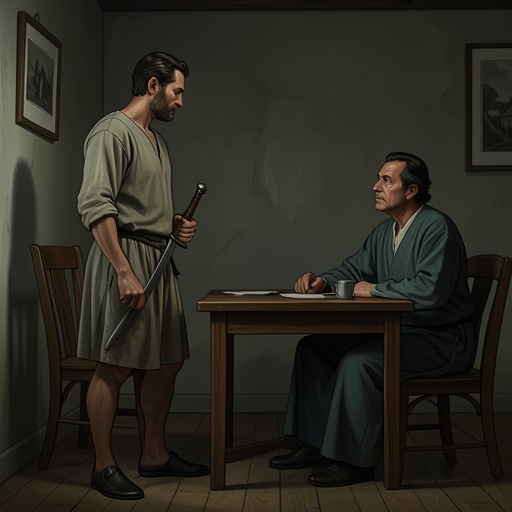
Don Quixote’s maxims for Sancho’s government
Don QuixoteDon Quixote’s maxims for Sancho’s government turn the approaching governorship into a test of judgment rather than a reward to be enjoyed. Before Sancho takes office on the Island of Barataria, Don Quixote counsels him on humility, justice, and personal conduct; later, a letter extends that advice into the daily work of governing. The counsel is striking because Don Quixote can speak with measured clarity on public affairs even while the history repeatedly distinguishes this sound understanding from his delusions about chivalry.
Occasion and Governing Principles
Sancho’s appointment comes as a surprise to both master and squire. Sancho admits that he knows little of letters, but trusts his memory and expresses readiness to serve. Don Quixote, with the Duke’s permission, takes him aside, closes the chamber door, and makes him sit down so he can advise him before the new responsibility begins. The intimacy of the scene gives the counsel the quality of instruction between companions, while Don Quixote’s recognition that office is a gulf of troubles warns that rank brings burdens as well as honor.
He first tells Sancho to fear God and to know himself. The paired principles join moral accountability to awareness of one’s limits: a governor should not mistake sudden advancement for proof of personal superiority. Don Quixote reminds Sancho of his humble beginnings, but Sancho answers that his origins do not disqualify him, since governors need not come from royal families. Their exchange makes the lesson more than a demand for deference. Self-knowledge should temper vanity without turning social birth into a measure of fitness to govern.
The advice also distinguishes compassion from favoritism. Don Quixote says that the poor person’s tears should awaken more compassion, but not more justice, than the rich person’s arguments. The governor must seek truth amid both a wealthy litigant’s promises and presents and a poor petitioner’s sobs and entreaties. When equity allows room to temper the law, he should not impose its utmost severity on the guilty: a judge’s reputation rests not only on firmness but also on compassion. Don Quixote thus presents justice as neither blind harshness nor a preference for the visibly distressed, but a disciplined search for truth that remains alert to unequal circumstances.
Judgment, Restraint, and Public Trust
Other maxims address how office can be corrupted or made credible. Don Quixote warns Sancho against arbitrary judgments, and against allowing private advantage to enter the household or conduct of public business. If Sancho should become a widower and seek a higher-ranking spouse through his office, he must not treat what she receives as irrelevant to his own responsibility. The warning connects private choices to public accountability: a governor cannot separate his conduct from the consequences attached to his position.
Don Quixote’s later letter develops that point into a compact program for maintaining public trust. Sancho should dress neatly and appropriately to the duties of office, not simply follow his personal preference for humility. He should be civil to everyone and ensure that food is abundant, since hunger and high prices weigh especially heavily on the poor. His proclamations should be few, but good and actually enforced. Rules that remain unenforced, Don Quixote cautions, lose authority and invite contempt, like the log appointed king of the frogs, which first frightened them and was later disregarded.
The letter counsels a balance between severity and leniency: Sancho should support virtue and oppose vice without making either strictness or indulgence his invariable habit. He should visit the prisons, slaughterhouses, and markets, where a governor’s presence can comfort prisoners and encourage fair dealing by those who sell goods. These visits make oversight visible in places where official authority has immediate consequences. Don Quixote also warns him not to let people identify a special weakness, such as greed, appetite, or susceptibility to women, and use it to influence him. Good government, in this account, depends both on sound rules and on a governor’s ability to prevent private appetites from becoming public leverage.
The Governor’s Person and Speech
A substantial part of the first instruction concerns Sancho’s manner and habits. Don Quixote tells him to keep clean, cut his nails, and wear orderly clothing, treating personal presentation as one sign of whether a person can meet the demands of office. If Sancho can provide liveries for servants, he should choose useful and respectable clothing rather than display, and divide the benefit between servants and poor people. The example makes generosity a practical decision about how limited resources are distributed, not merely a private sentiment.
He also advises Sancho against arbitrary comparisons between families. Such judgments risk making enemies among those disparaged while bringing no dependable benefit from those praised. His advice about riding, sleep, and diligence likewise treats bearing as part of public conduct: a governor’s posture, habits, and appearance can affect how his office is perceived. The counsel does not require Sancho to pretend to a noble birth; it asks him to acquire the discipline and decorum appropriate to the responsibilities he has accepted.
Speech receives its own correction. Don Quixote asks Sancho not to crowd his conversation with proverbs, though he accepts that a proverb used aptly can be effective. Sancho explains that maxims come to him in such abundance that they seem to compete for a place in his speech, then immediately strings several together. The exchange turns instruction into comedy without dismissing its point: a governor needs not only inherited sayings but judgment about when words fit the matter at hand. Don Quixote’s correction is itself measured, distinguishing useful proverbial wisdom from indiscriminate accumulation.
The Letter During the Governorship
Don Quixote returns to the subject in a letter addressed to Sancho as governor. Its occasion is news that Sancho has shown good sense, contrary to Don Quixote’s expectation that he would make blunders. The letter praises his humility but cautions him not to let modest personal taste obscure the outward requirements of office. It then restates and sharpens the earlier principles: civility, adequate food, enforced laws, balanced judgment, and vigilance against corruption.
The letter also asks Sancho to show gratitude to the Duke and Duchess, whose favor and assistance he has received, and to keep Don Quixote informed about events in the governorship. Its private details coexist with its public instruction: Don Quixote mentions his own recent discomfort and asks whether the majordomo had a part in the Trifaldi performance, which Sancho had suspected. He says that he may soon leave the idle life at the castle because he must follow his calling rather than the pleasure of his hosts. The correspondence therefore binds practical counsel to the continuing, sometimes comic, complications of their shared life.
Wisdom in Contrast
The narrative explicitly contrasts Don Quixote’s reasoned counsel with his talk of chivalry. On ordinary subjects, it observes, he can display sound judgment and rectitude; his intellect and his actions diverge when the chivalric delusion takes hold. The maxims make that distinction concrete. They are not instructions for a knightly adventure but a sustained account of justice, restraint, public service, and personal discipline.
Their force also lies in how they address Sancho’s particular position. He is inexperienced in formal learning and suddenly entrusted with authority, yet Don Quixote does not reduce good government to education or rank. He asks Sancho to know his limits, listen fairly, control his interests, and attend to the needs of people subject to his decisions. The repeated emphasis on enforceable rules, visible oversight, and compassion gives the counsel a practical shape: authority is credible when it serves the public and can be trusted to judge without favoritism. Sancho’s appointment may originate in the Duke and Duchess’s arrangements, but Don Quixote’s advice treats the office as a real moral responsibility.